
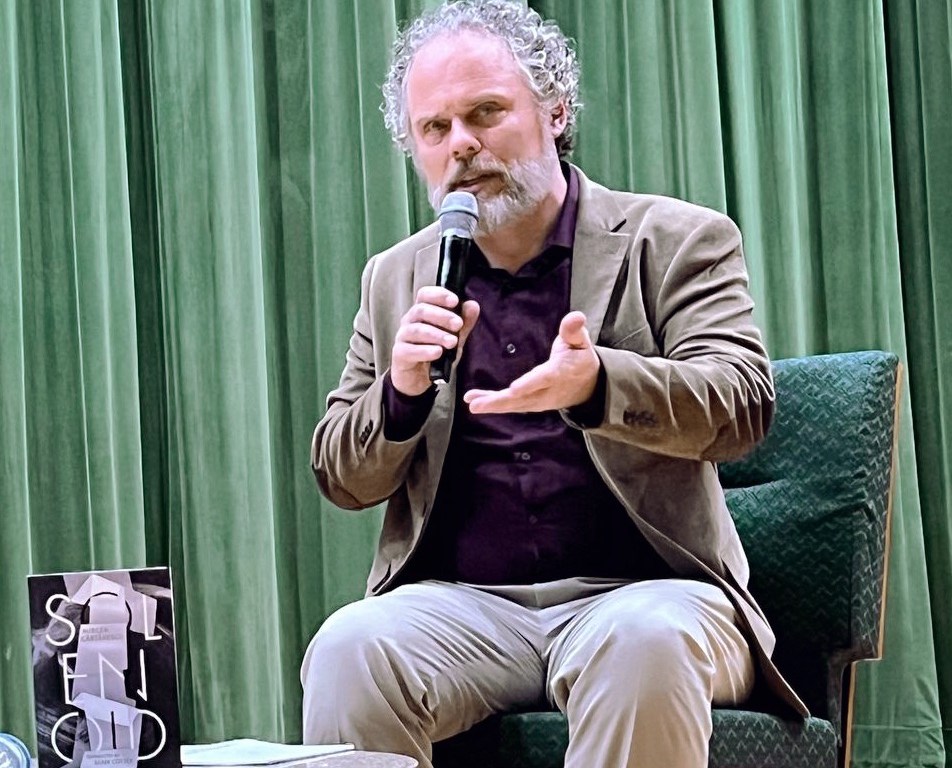

SEAN COTTER is Professor of Literature and Literary Translation at The University of Texas at Dallas. He has translated numerous important works of Romanian literature, including Wheel with a Single Spoke and Other Poems by Nichita Stănescu, for which he received the Three Percent Best Translated Book Award 2013, Blinding: the Left Wing by Mircea Cărtărescu (Archipelago Books, 2013), Curl by T.O. Bobe (Wakefield Press, 2019), a finalist for the Derek Walcott Prize for Poetry 2020, and more recently, Rakes of the Old Court by Mateiu Caragiale (Northwestern University Press, 2021) and FEM by Magda Cârneci (Deep Vellum, 2021), a finalist for the 2022 PEN Translation Prize. His translation of Mircea Cărtărescu’s Solenoid (Deep Vellum, 2022) won the much coveted Los Angeles Times Book Prize for Fiction and appeared on The New Yorker’s list of Best Books of 2022, Publisher’s Weekly’s list of Best Books of 2022, The Financial Times’ list of Best Books of 2022, The Washington Post’s list of Best Books from 2022, and Words without Borders’ list of Best Books of 2022. It also won The Romanian Cultural Institute Award for the best translation of a book from Romanian in 2022. Professor Cotter is the author of Literary Translation and the Idea of a Minor Romania, which was awarded the prize of the Society of Romanian Studies in 2014. He holds a degree in English Literature from Loyola University, New Orleans, a master’s degree in Humanities from The University of Texas at Dallas, and a doctorate in Comparative Literature from the University of Michigan.
DB: I’ll take my chances to start by asking you a couple of questions that you’ve probably heard a hundred times: how did you come to learn and how did you end up translating from Romanian? How did your love story with Romanian literature begin?
SC: I learned Romanian by living with a family in Bucharest, by participating in the Peace Corps training, and by watching American TV subtitled in English — Santa Barbara, above all. While teaching high school English in Bucharest, I kept a list of the authors my colleagues mentioned in the teachers’ lounge between classes. I would paw through the many kiosks selling used books, read what I could, and come back to the lounge with questions. My aim was to learn as much literature as my high school students did, from my highly qualified colleagues.
After Peace Corps, I was surprised to find many editors interested in Romanian literature. I had underestimated their desire for something that seemed “exotic” to them. I continued to translate, and I continued to learn Romanian. I am still learning, and that’s not a platitude. I am constantly aware of the deficiencies in my facility, my accent, my use of idioms, even my mistakes in gender and articles. Polly Barton paradoxically observes that now, after years of working with Japanese, she feels she speaks it worse than before she started learning the language. Well do I understand her.
DB: How long does it take to become a translator and how much work goes into it? And also: how do you train up a translator? How do you teach the secrets of the trade?
SC: In “The Perfect Critic,” T. S. Eliot argues that, in order to interpret and evaluate literature, the critic should have “infinite knowledge.” How much more knowledge and skill, then, does the translator need, when she must not only interpret but reproduce literature? To become a translator takes infinite work. The University of Texas at Dallas program helps students develop their identity as translators, to learn the vocabulary of the field, to appreciate the depth and complexity of translation problems. Students arrive with excellent proficiency in their languages, and usually with a limited sense of translation’s possibilities. Most would like to be told the right way to handle various translation problems, but translation is more complex than right or wrong, more interesting than saying, “până is sometimes ‘until’ and sometimes ‘even,’ depending on context; dor is untranslatable.” In our program, they complete two years of courses, including at least four specifically in translation, translation theory, and translation history. Students also take seminars in literature, literary theory, creative writing workshops, and when their projects require it, courses in philosophy, history, art history, etc. In this way, we consider the complete picture of professional, intellectual, and creative aspects of translation. I have a current student who is translating a poet who combines language and visual art, so the translator is learning lithography alongside her research in Latin American poetry. I had another student whose translation project led her to create a series of color-based dance pieces. Students usually include a translation as part of the dissertation, and many have gone on to publish their works. We teach some techniques, some “secrets,” and of course we teach students how to present themselves to publishers, how to pitch their books, how to work with authors, etc. But we are really aiming to bring students to an encounter with the vastness and richness of translation as a field of inquiry, to give them the conceptual tools and skills, and to let them go explore.
(…)
DB: Rakes of the Old Court by Mateiu Caragiale, Blinding and Solenoid by Mircea Cărtărescu… it’s hard not to notice that you have a propensity towards difficult texts. What is the biggest challenge you have faced as a translator?
SC: It is difficult to think of a translation that is not difficult! Caragiale and Cărtărescu seem difficult because they are challenging to read. But even accessible books present problems for translation, because we must not only read but re-write. I’ll take a book I haven’t translated as an example: the direct, realistic style of Ioana Pârvulescu’s Viaţa începevineri might appear easy to translate. Her story about a time-traveler is both brilliant and straight-forward. Toward the start of the book, characters from the late nineteenth century attempt to describe sneakers from the twenty-first, in a series of comparisons with shoes of the earlier epoch. To translate this scene into English we need not just a set of synonyms for shoe, but a particular set of old shoes that are close to but not actually sneakers — a set of antique not-sneakers. While we try to solve that problem, one character begins to roll his r’s “as in French” — but in the US. “French” signifies a more guttural r; we associate rolled r’s rather with Spanish. While we consider that problem, another character uses abbreviated forms of dumneata, a form of address without a match in the English of the nineteenth century or today. Beyond these local problems, we have to keep an eye on the ways this scene might interlace with the book’s interest in time: what might be and what is. And we pay attention to Pârvulescu’s mastery of pace. And most importantly, we have to aspire toward the luminousness that suffuses her writing, in this book and others. Suddenly, a book that we might think is not difficult is full of translation problems. I am very curious to see how Alistair Ian Blythe handles this text. It must have been an engaging project. But to answer your question directly: the idea of translating Arghezi seems overwhelmingly difficult. And for very different reasons, I’ve never been able to capture the charming lightness of Ion Minulescu. But the real challenge I face as a translator is a lack of time. If only I had infinite time, I believe I could find a way to translate the depth of Arghezi and the shallowness of Minulescu, and one thousand other authors I would like to translate.
(…)
DB: How involved are you in promoting the books you translate?
SC: It depends on the press and the project. I’ll give two extremes: for Liliana Ursu, I was very involved; I organized a tour with eight events in five cities from Boston to Dallas, and I accompanied her for all events. For Mircea Cărtărescu, Romanian Cultural Institute in New York and Deep Vellum arranged a marvelous tour from coast to coast of the United States, and I only participated in the events in Dallas. So, there’s a great variety of involvement. Translators are often good promoters of their books and their authors, sometimes because they are the only ones who know the text. I enjoy the promotional events, because it is interesting to learn, first-hand, how American audiences react to the work.
DB: Do you think that interest in Romanian literature in English translation has increased along the years? What can be done for this to happen or to happen faster?
SC: It is certainly true that interest in the US for translated literature has increased. If, in the past, writers from “Eastern Europe” benefitted from special attention, for example Philip Roth’s series “Writers from the Other Europe,” or Northwestern UP’s “Writers from an Unbound Europe,” today Romanian authors compete with authors from around the world. I think our watchword must be “consistency.” Romania does not suffer from a lack of international-caliber authors; there are many, many more works to translate than we have translators into English. We need to consistently produce these works in English, to secure Romania’s place in this market. We should be thinking about decades of effort. One author can break the ice, but the waters will refreeze if more do not follow. I think about a soccer analogy: we could be Norway, with occasional breakthroughs from players like Haaland and Ødegaard, or we could be Brazil, consistently present in the international game with more players than we could name. I think Romania’s authors are better than its soccer players (pace Hagi!), and we have every chance of being the Brazil of world literature.
(…)
DB: Luckily for us the Center for Translation Studies at the University of Texas at Dallas and Deep Vellum publishing house, both places where Romanian literature has found a welcoming home, are based in the same Texan city. How has your relationship with Deep Vellum developed and what projects are coming up next?
SC: We have a very special opportunity in Dallas. I don’t know of another situation like this one, where the academic and the commercial can work so well together. The UT-Dallas doctoral program is fully funded — all tuition, fees, and health insurance paid, plus a student stipend — guaranteed for five years. Students may also come for coursework alone and earn a Masters with a Certificate in Literary Translation, in two years. At the same time that UT-D has such opportunities for translators, we have Deep Vellum, one of the most important literary presses in the United States, a solid partner for Romanian literature. The dynamic and visionary Will Evans is convinced of the quality of Romanian authors and their salability in the US market. Starting this semester our relationship will become even closer, as Will teaches a class on publishing at UT-D. So, we have support for the production of translations and a gifted publisher to make them visible in the US. All we need is a steady flow of students! Will and I are talking about many books to come, more Cărtărescu of course, but others as well. Important for me is that we involve as many translators as possible, to make sure the books appear on a regular basis. I hope those translators will come from our program.
The interview was originally published in Translationes, the journal dedicated to literature in translation of the West University of Timișoara, no 15/2023. You can read the full text here.
 CEVA LA MIJLOC