

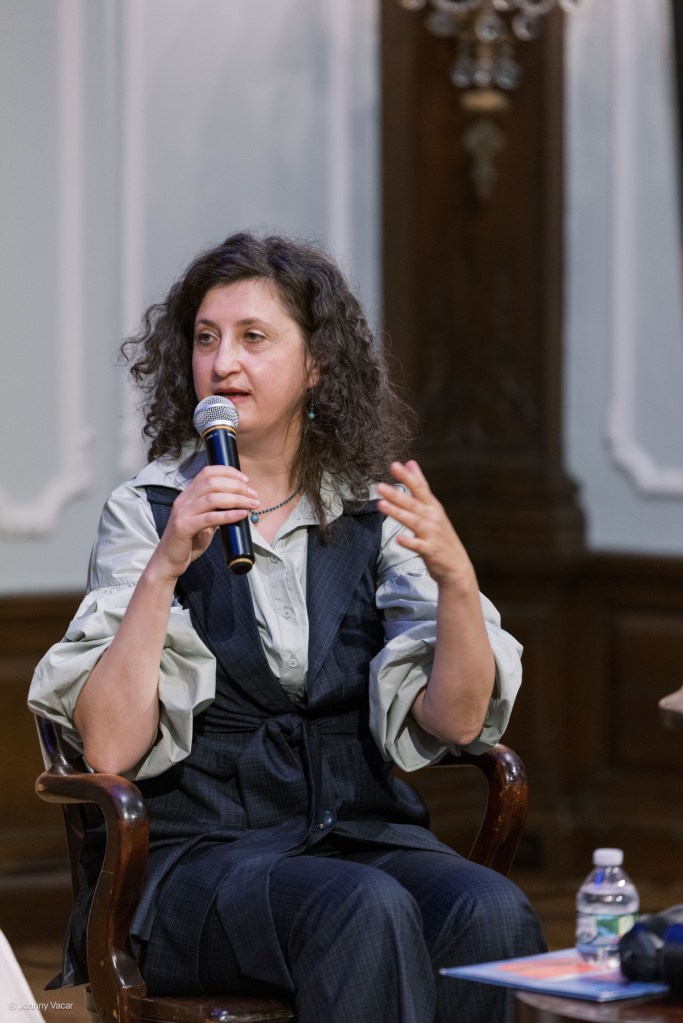
Born in the Republic of Moldova, LILIANA COROBCA is a novelist, essayist, and playwright whose work explores the fragile boundaries between history and memory, exile and belonging, censorship and resistance. She debuted with Negrissimo (2003), winner of multiple prizes, followed by A Year in Paradise (2005), Kinderland (2013), and The Old Maids’ Empire (2015). Her bold theatrical monologue Censorship for Beginners (2014) has been staged internationally, while The Censor’s Notebook (winner of the 2023 Oxford‑Weidenfeld Translation Prize), Kinderland, and her latest novel, Too Great a Sky, translated by Monica Cure and published by Seven Stories Press, have earned her wide critical acclaim in the United States.
At the end of October LILIANA COROBCA was invited to take part in the 2025 European Literature Night in New York, joining fellow authors and translators from across Europe in the largest annual celebration of European writing in the United States, organized by EUNIC New York together with PEN America.
In this exclusive interview for the Romanian Authors in English blog, she discusses her creative process, the ways memory, history, and personal experience inform her writing, and the ways her work connects with readers across languages and cultures.
One of the themes featured at this year’s European Literature Night in New York was “The Past’s Presence.” How do you see this idea manifesting in your own work?
At present, I have three novels translated into English, though each author was asked to propose only one, and I chose the most recent translation. I believe, however, that my novel about censorship or the one about children abandoned after their parents’ emigration would also have been fitting choices. Many of my books originate from a powerful moment in our recent past, yet for me, the past serves as a pretext to examine the present and the future with a more informed and perceptive eye—or as a source of possible solutions to contemporary problems. I believe that any work of contemporary literature, regardless of how distant its subject may seem, ultimately speaks to the present. Today we find ourselves increasingly close to repeating the mistakes of history, and through our books, we sound the alarm.
Documentation can take many forms — from archival research to real-life observation. In your writing, how do you balance documented reality with invention? How much of what appears in your books comes from research and how much from imagination?
I must admit that about ten years ago, in a television interview, I confidently declared that fiction is fiction and research is research, and that the two never intersect in my work. My interviewer then asked, quite innocently, “And you will never write a novel about censorship?” “Of course not, under any circumstances,” I replied with conviction. At the time, I saw myself as the kind of writer with boundless imagination, one who had no need for documentation.
Of all my novels, the most rooted in documentary material are The Censor’s Notebook and, more recently, The Master and Makarenko, which explores the role of the Soviet pedagogue Anton Makarenko in the so-called Pitești Phenomenon. In 2009, I edited a collection of testimonies from Bukovinians deported to Siberia, and the novel on that subject appeared ten years later. By then I had forgotten many of the deportees’ stories, but certain details had left a profound mark on me. I used some real elements, yet I transformed them extensively—expanding and intensifying details that witnesses had mentioned only in passing. I also imagined those moments they avoided, with the restraint of peasants who endure the greatest humiliations with dignity.
Some invented scenes appear utterly real, and I believe this is an area in which I excel. In my debut novel, I invented an underground association of ghostwriters who compose texts for celebrities whose inspiration has dried up. Many readers were convinced this phenomenon actually existed, even believing I had been involved myself—and some even offered me a job “in the field.” It is not impossible that such a phenomenon does exist, and that, without realizing it, I invented a reality.
You’ve also published collections of documents and other nonfiction materials. Why do you feel that some of these stories belong in literature? What do you think changes — or is gained — when real stories are reimagined through fiction, especially in terms of emotional or cultural impact?
There would be much to say for each novel individually, but I will focus only on Capătul drumului (The End of the Road / Too Great a Sky). After publishing the volume of documents—which reached only a limited audience and had modest visibility—the novel greatly expanded both its reach and its impact. Published by a prestigious press, with proper promotion and critical attention, the previously unknown story of these people found a much wider readership. Following the publication of the documents, I realized that the subject remained a terra incognita, and that fiction could help change this. And indeed, that is what happened—especially through translation, which made the story accessible to an even larger and more diverse audience.
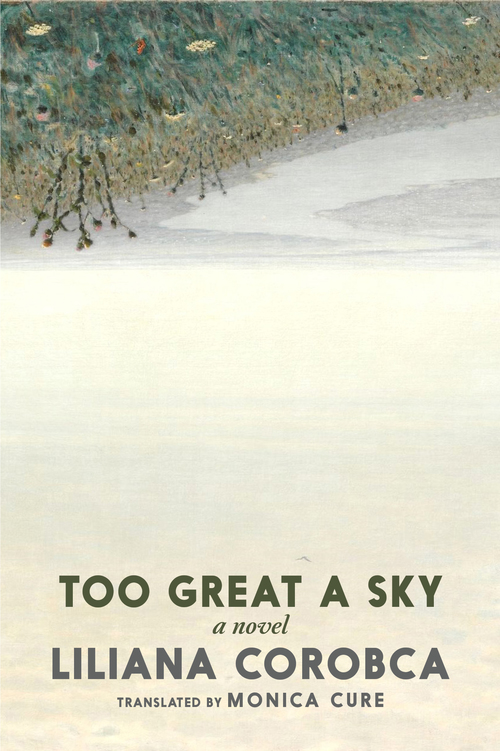
- Too Great a Sky, recently shortlisted for the prestigious Warwick Prize for Women in Translation, follows its characters across vast emotional and physical landscapes, weaving personal and collective histories into lyrical, deeply moving prose.
How do you usually build your characters? Do you know them well from the very beginning or do they reveal themselves gradually as the story unfolds? I’d extend this question as well to the development of action and plot.
If I were to step back and look at my nine novels sine ira et studio, I would divide them into two categories: those that begin from a scene, an image, or a vision (A Year in Paradise, Too Great a Sky, The Master and Makarenko), and those that originate from a real person (Kinderland, Ladybug). Sometimes I know the final scene before the opening one; I have an elaborate structure in mind, even a table of contents with the novel’s parts or chapters. Yet as I write, things change—I abandon some constructions and adopt others that seem to fall naturally into place.
For Kinderland, the novel began after meeting a traumatized little boy. I spoke with him, learned his tragic story, and although he is not the main character, that encounter in my village was the spark that set the book in motion. Too Great a Sky would never have been written without a series of crosses that began to appear to me—in dreams and in reality—slender, pale wooden crosses emerging from a foggy landscape, countless of them, near and far. “Why do they keep appearing to me? Why can’t I escape them?” I asked myself, especially since I was not raised in a religious environment—quite the opposite. I saw my first Bible only after the fall of communism and learned the “Our Father” at the Faculty of Letters, in the Romanian–Latin department, as an example of the Latin roots of the Romanian language. I hesitated to approach the subject because the survivors whose testimonies I edited—and others, for instance from Moldova—were deeply religious, and I feared speaking from within such a character’s experience.
Even after finishing a novel, I can rarely say whether a character has blue or brown eyes, whether they are tall or short. I don’t see them—I feel them. Instead, I see the scenes unfold, hear the voice, sense the gaze, the attitude, the intensity of suffering or joy. Sometimes the emotion is so overwhelming that my eyes fill with tears and I can no longer see what I’m writing. Some characters remain nameless for a long time; their names appear late. Some I release easily—others, with great difficulty.
In Too Great a Sky, the book that was presented at ELN, you write about the deportation of Romanians from Bucovina to Kazakhstan in World War Two — a subject still insufficiently known, even in Romania. What drew you to this particular historical moment and what gaps did you feel the novel could fill in public memory?
I don’t believe any writer begins a book with the intention of filling public memory. I remember asking myself instead whether I would be able to complete such a difficult story—whether the character would remain by my side for as long as it took. The final scene, at the end of the road, when Ana’s youthful lover returns to her after more than fifty years of separation, appeared to me vividly, almost cinematically: I saw the table with the pies, the old house, the courtyard, I felt Ana’s anticipation—an old, solitary woman in a deserted village. Yet I never wrote that scene. I stopped after a single sentence, not a word more.
It was not the deportation itself, as a historical event, that moved me the most, but rather the survival—the optimism of the deportees, their sheer will to live. This stands in stark contrast to our own lives of comfort, which we value so little, as we sink into depression and weep over the smallest mosquito bite.
Your background as a scholar of communism, censorship, and exile is reflected again here, though this time the focus shifts to forced exile and mass deportation. How did you approach this difficult themes, both artistically and emotionally?
I believe I was the right person for the right subject. Today, I could no longer write such a book. Emotionally, it is far more difficult than artistically—and those perfect scenes you imagine so vividly often lose their power once you put them on paper. In the end, everything you research, see, feel, and experience serves as general preparation for an exam. The book becomes a cocoon from which a butterfly will eventually emerge and fly, while the author must cut all the silk threads that held it tightly bound, immobilized beside the cocoon, until the butterfly is ready to take flight. It is both torment and delight at once. Each novel poses its own challenge, a new subject that I take on and draw close to myself, feeling it in a way that would be impossible were I merely an outside observer.
In the novel, Ana’s deportation begins at the age of eleven, yet the narrative is imbued with wisdom, reflection, and at times restraint. How did you approach portraying a child’s trauma without falling into sentimentality?
Indeed, Ana lives through several ages, and I believe this is natural when we recount our own stories from different points in life. Older people, too, often tend toward sentimentality, softening or even idealizing their past. I think Ana’s deep faith, modesty, curiosity, and sense of humor protects her from that temptation. Yet, like any elderly woman, she is astonished by the inventions of the modern world and by young people who no longer truly communicate, absorbed instead in their phones. We do not always learn from the hardships we endure—but Ana did, and I hope that her great-granddaughter, who listens to her story, will learn as well. I believe in the moral and educational power of good stories. I think reading can make us better.
Too Great a Sky spans extreme circumstances — deportation, exile, labor camps, mass murder, and a return to a completely transformed homeland. How did you balance the portrayal of suffering and trauma with moments of daily life, humor, faith, and resilience?
A very good observation. Too Great a Sky is neither the only nor the first of my novels in which I explore survival under extreme conditions. When the subject is deeply painful, I find that, in order to continue writing, I must weave the harsh scenes together with moments of tenderness, calm, and serenity. I also think of the reader, whom I have no desire to traumatize with my books. The balance comes naturally—it feels simply like what must be written. The sun rises every day, but one must spend weeks locked in a dark cattle car to truly appreciate a single ray of light. And humor, alongside prayer and song, is another form of medicine that I “prescribe” in all my writing—for the well-being of my readers, and for the sometimes long journey toward happiness.
There’s a quiet yet powerful presence of nature throughout the novel — weather, birds, animals (both domestic and wild), trees, huge bodies of water, the sky. Was this an intentional counterbalance to the cruelty of history, or something that emerged organically in the writing process?
Both. I was born and raised in a village surrounded by forests, hills, and small rivers. I grew up among dozens of animals, whose absence I now feel deeply living in Bucharest. I try to compensate for that loss by filling my books with the animals that once surrounded me. Yet they serve a purpose far greater than sentimental decoration—animals sustain us in difficult times, and I wanted to highlight that essential truth.
Faith and religion play a significant role — in Ana’s prayers and the community’s rituals. How does faith function for your characters as both a survival strategy and a moral compass?
The survivors of the deportations often repeated in their testimonies that their faith in God sustained them—that they would not have survived without it. It is easier to endure hardship when you believe that God is beside you, when you see sadness itself as a kind of sin, and when you can still perceive light even in moments that seem utterly hopeless. I have learned a great deal from my faithful characters, especially since I did not grow up in a religious environment—churches in our country were closed, and religious literature was forbidden. I also wanted faith to serve as a model for today’s disoriented young people.
Music, songs, folk riddles, and prayers appear throughout the book, woven into the narrative. What meaning did you find in incorporating these oral and folk elements into the story?
First, these elements serve as a counterbalance to tragedy; secondly, they help to preserve and popularize Bukovina’s folklore and traditions. As a student, I collected folklore from my village and later wove some of these rituals, songs, and chants into the train journey in the novel. I also researched the rituals of those deported to Kazakhstan. Alongside faith, singing has a profound therapeutic value—I know this from my own experience and encourage others to try it when they feel sad. In my family, grandparents and parents always sang, hummed quietly, or improvised playful melodies, sometimes as a humorous response to life. I inherited this habit and was surprised to discover that today, people rarely sing for themselves anymore. Many believe singing requires formal training or equates only to performing on stage, but I mean singing for oneself—as a state of mind, a source of calm. An angry or furious person cannot sing.
In working with translator Monica Cure on Too Great a Sky, you’ve discussed the challenges of translating cultural references, multiple languages, songs, riddles, and vernacular voices. What were some of the most surprising or difficult moments of your collaboration and how did you make sure that Ana’s voice resonated in English?
Monica Cure wanted to grasp the context, the style of writing, and the perspectives and voices of the characters. Our discussions were long and enjoyable, and often we searched for additional explanations beyond the text to find the most fitting English equivalent. The Kazakh words posed the greatest challenge. I researched prose anthologies from the Soviet period, translated into Romanian and written in Russian letters, so I did not know how they appeared in the original. Monica raised a crucial question: what if a Kazakh reader said that such words or expressions do not exist in their language? For the chapter on the lives of Romanians in Kazakhstan, I carried out extensive research for the English edition, and Monica even consulted a fellow writer settled there, who in turn asked Kazakh colleagues about the authenticity of certain words or customs. Many expressions and puns, rich with folk flavor, proved particularly difficult to translate.
Monica Cure’s translation captures not only the story, but also the rhythm and emotional register of the Romanian text. Were there any passages where the English version revealed something new to you about your own writing?
I was delighted when people told me or wrote that Monica’s translation was remarkable. My English is not strong, and I do not usually read literary fiction in English, nor do I often compare translations—though I suspect I would learn the language faster if I read my own books in other languages. Recently, reading an excerpt of the novel in English at the European Literature Night in New York, I felt the text was very close to me, entirely my own. Monica had perfectly captured and conveyed my voice—she felt it and understood it—and I am deeply grateful to her for that.
How do you imagine readers in the United States might connect with your books, especially regarding themes like historical memory, identity, and exile? And what has your experience been in other countries where your work has been translated?
Themes such as identity, migration, exile, censorship, and survival know no borders—almost everyone can recognize or be affected by them. Yet the American public may not be well informed about the social or historical contexts of Romania or the Republic of Moldova. On my German tour, for example, at some book events I had a map of Europe behind me and began by showing where Moldova is. Audiences asked about the population of Romania and Moldova, or about the number of children left behind due to migration. I hope that even those not particularly interested in these countries are drawn by their curiosity and love of literature, eager to read stories from places unfamiliar or exotic to them. Conquering the American audience may be challenging, but it is certainly not impossible.
Interview by DACIANA BRANEA, New York – Bucharest, October-November 2025


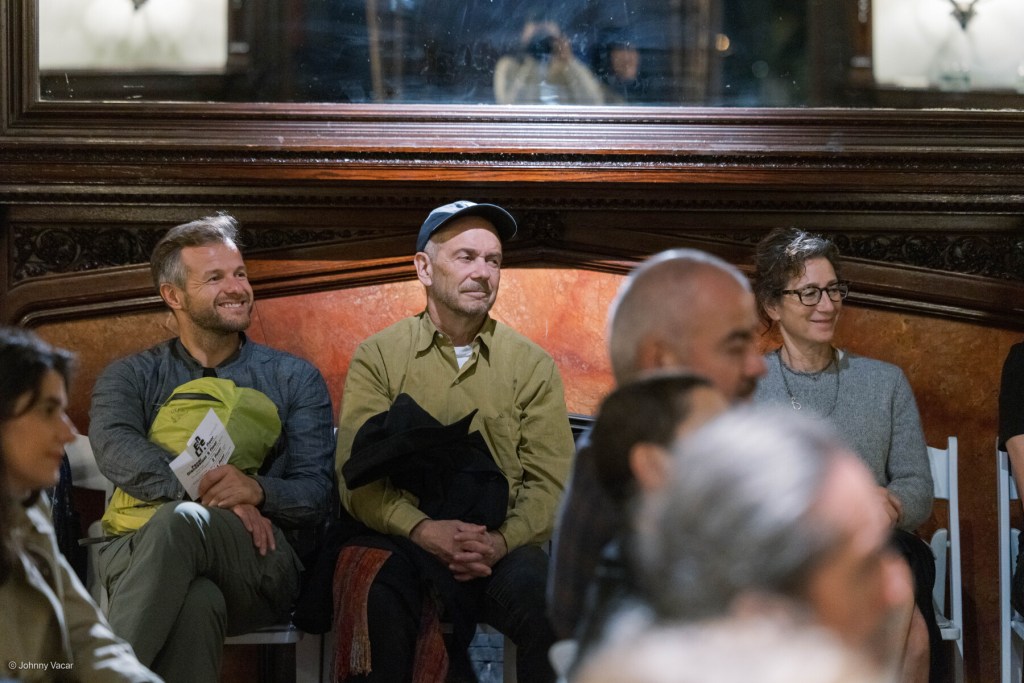
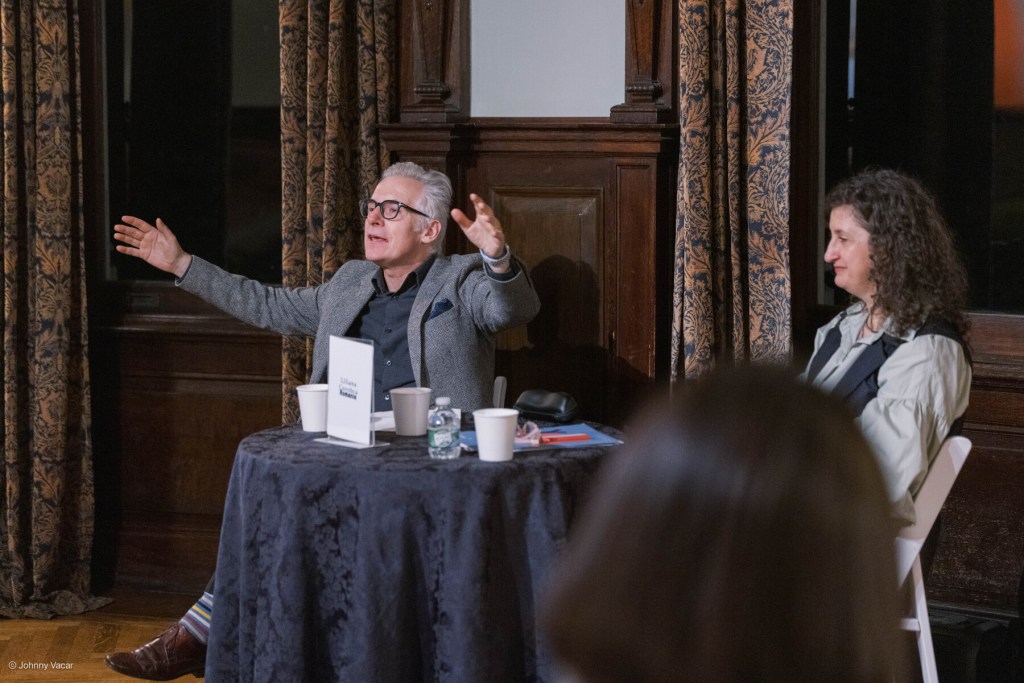
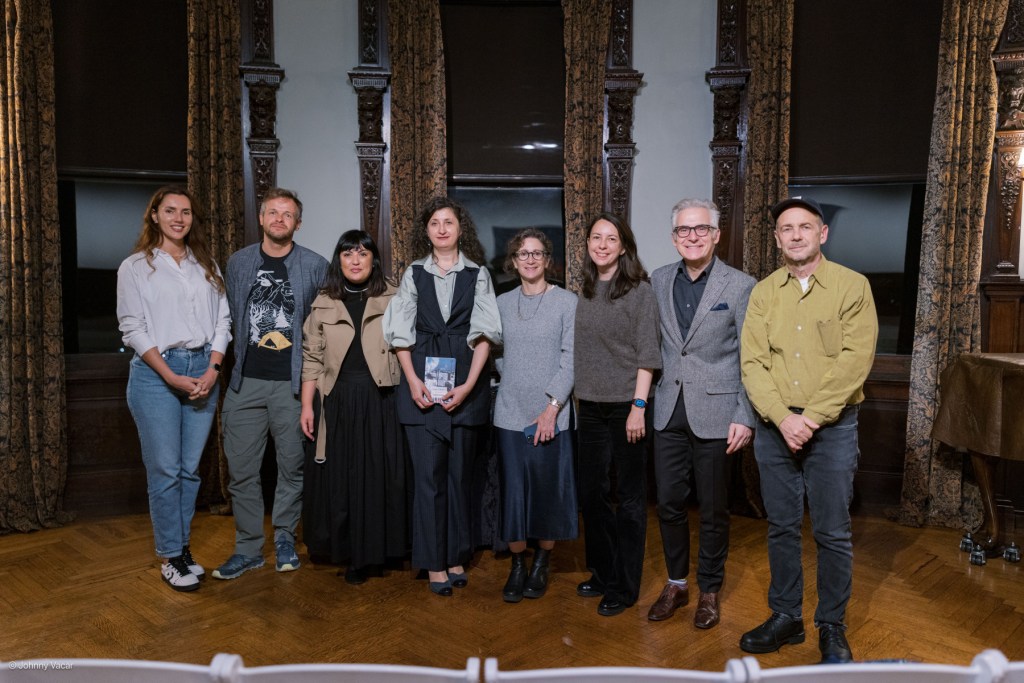
Cover photo by Ema Cojocaru; photo gallery by Johnny Vacar (Liliana Corobca at European Literature Night in New York together with the teams of the Romanian Cultural Institute & Seven Stories Press, Ukrainian Institute of America, October 23, 2025)
 CEVA LA MIJLOC