
According to general belief, translations from Romanian into English are scarce and mostly unsatisfactory. In reality, the major libraries of the English-speaking world host more than 500 Romanian books in English translation, including most canonical titles, from which English readers can get a clear idea about the evolution of Romanian literature over more than 100 years. Although the translations are unequal and some of the books can be difficult to access, this is a substantial and valuable bibliography, definitely worth revisiting.
Have you ever wondered how many Romanian books are available in English translation? The most common assumption among Romanians themselves is that the number is small to very small (and, in any case, insufficient). I started from this pessimistic assessment, with the secret hope to see it at least partially contradicted, to find out how big the library of Romanian authors in English translation actually is.
For this, I gathered information about Romanian books in English translation that can be found in the collections of major libraries of the English-speaking world, such as the US Library of Congress, New York Public Library, and British Library. I payed attention primarily to fiction, non-fiction and poetry, but I didn’t discriminate also against humanities (history, cultural history, art and art history, etc.).
My searches resulted in a bibliography of over 500 volumes, comprising approximatively 30% prose and 40% poetry. It’s not overwhelming but it’s quite substantial, as the list includes many great works of the Romanian literary canon and not a few contemporary gems.
Of these, a large number are translations from before the fall of the communist regim in Romania in 1989. Some appeared at Romanian publishing houses (being obviously aimed abroad, although in most cases they had almost no circulation at all); others were published abroad, by a few publishers with direct links to Romania or by some who were either simply interested in Romanian literature or had grown fond of certain Romanian authors (a good example being the British publishers’ clear preference for Romanian poet and playwright Marin Sorescu, which lasted well into the new century).
Most of the titles translated during the communist period are books by Romanian literary classics, such as Mihai Eminescu (who dominates the selection), and great modernist authors like Lucian Blaga, Tudor Arghezi and Liviu Rebreanu, but there are also a few contemporary authors, among whom the foreign publishers’ favorites, if we take into consideration the number of books published, are Mircea Eliade (who lived part of his life in the United States), Marin Sorescu and Nichita Stănescu.
After 1989, the situation changed significantly when, at the end of the 1990s, the Romanian Cultural Foundation’s publishing house was established, and especially after 2006, when the rebranded Romanian Cultural Institute & National Book Center set up their special programs meant to support both translations and the publication of Romanian books in translation by foreign publishers. It is thanks to these long-term programs that, if we now look at the total number of translated books along the years, the number of books in translation published abroad appears to be much higher than the number of those published in Romania.
Unfortunately, in comparison to other languages, the situation in the Anglosphere is more precarious, due to a complex of factors including the reduced number of professional translators and the small number of publishers adventurous enough to take the risks (mostly niche publishing houses with relatively low dissemination power), in the context of the general lack of appetite of the market-oriented British & American publishers for literature in translation (representing only 3-5% of all annual publications).
Among the most active foreign publishing houses that have been publishing Romanian literature in English translation over the last two decades, some of them constantly and in some cases with remarkable success in terms of critical feedback and prizes won, are Deep Vellum, Dalkey Archive Press (later taken over by Deep Vellum), Istros Books, Bloodaxe Books, Archipelago Books, Seven Stories Press, and New Meridian Arts.
The most translated authors of recent decades are Romanian-American writers Norman Manea, Nina Cassian, Carmen Firan, Petru Popescu and French-Romanian writer Dumitru Țepeneag (all of them, although living abroad, continued to write in Romanian), German-Romanian Nobel Prize winner Herta Müller, as well as Mircea Cărtărescu, Ana Blandiana, Ioana Ieronim, Ruxandra Cesereanu, Magda Cârneci, and on the shelf of late (re)discoveries, Romanian-Jewish inter-war author Mihail Sebastian.
The impetus behind putting together this list of translated books came from the countless discussions about the scarcity of translations from Romanian into English. However, this was by no means my only motivation: I think that having such a bibliography at hand is of great importante because it can serve not only as a useful working tool for researchers but also as a source of information for translators, publishers and, last but not least, all those interested in Romania and Romanian authors whose books can be found, in English translation, in bookstores and libraries in the UK, the US and elsewhere.
I shall not end this brief, perspective-changing introduction without adding that, although unexpectedly rich, this bibliography of Romanian authors in English translation is not, and cannot be, exhaustive. On the contrary, it remains work in progress by its very nature, and will be continuously expanded. All those who wish to contribute to amending or updating it are welcome to do so.
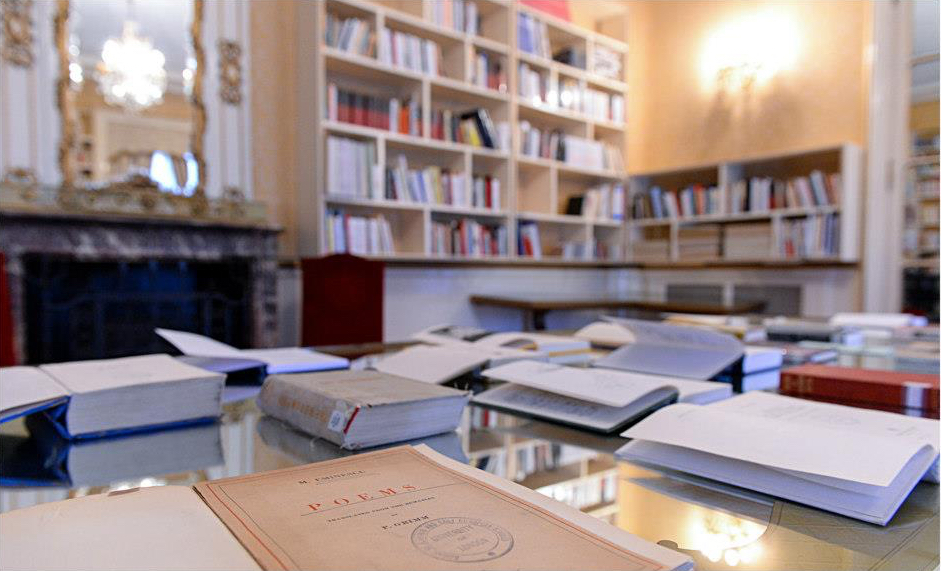
In the photo: The Romanian Library at the Romanian Cultural Institute in London © Razvan Danaila, 2013
 CEVA LA MIJLOC