

Norman Manea, the doyen of Romanian writers in the diaspora, turns 88 today, and congratulations and tributes have been pouring in for several days, in the press and on social media. A survivor of the two evils of the 20th century, Nazism and Communism, who has spent part of his life in exile in the United States, Norman Manea is not only one of the most important and beloved names in Romanian literature, but also one of its most lucid minds, a great conscience who looks with acuity at both the tragedies of history and the growing dangers of the contemporary world.
As there is no better way to show your love and respect for a writer than to actually read his books, I thought the most appropriate “Happy Birthday, Norman Manea” on this blog would be to invite those who haven’t yet done so to discover his latest novel, the career-crowning Exiled Shadow, which was launched in the US last year to impressive critical acclaim.
📖📖📖
Exiled Shadow was originally published in Romanian by Editura Polirom in 2021 and, shortly after, translated into Spanish (Galaxia Gutenberg, 2022), German (Hanser, 2023) and Italian (Il Saggiatore, 2023). A big success immediately upon its release in all these languages, the novel has been showered with praise by international literary critics and has received rave reviews from not a few of the author’s famous confreres. After its publication in English by Yale University Press, Mosaic Magazine and The Arts Fuse placed it on their lists of recommendations as one of the best books of 2023.
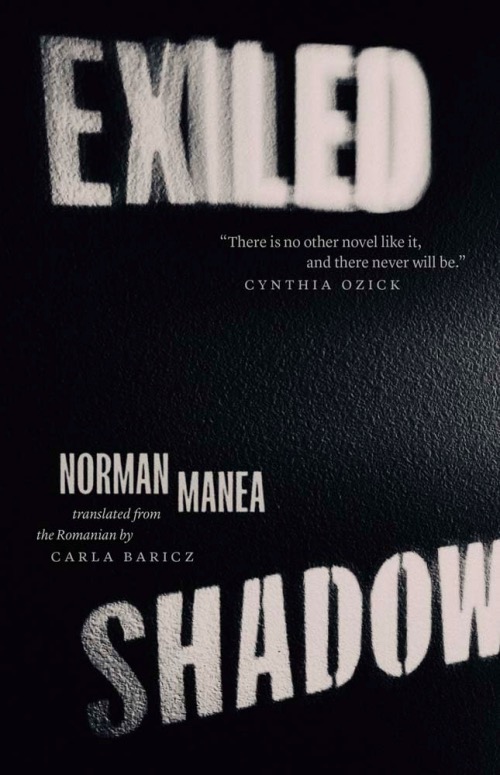
A reflection on exile and what it means to be an exile. … an accomplished work … an approachable read even as there is so much depth to it, in its many layers. … Well done and engaging — an impressive and significant chapter in Manea’s considerable body of work. — M.A. Orthofer, Complete Review
Exiled Shadow is saturated in reflections, dualities, and shadows, starting with the parallels between Manea and the novel’s unnamed narrator, refered to as the wanderer, the exile, the nomad, the walking stick, Suitcase, the Misanthrope, and the Nomadic Misanthrope. Throughout the novel, exile is posited and probed as the cure for that ‘wound that won’t heal’ identified by the younger Manea newly seeking refuge in ‘the country of all possibilities.’ … Baricz does a tremendous job differentiating the tones across various parts of Manea’s consistently thought-provoking and studiously intellectual latest work. … In its best moments, her translation even evokes another great exiled author in Nabokov. — Cory Oldweiler, Los Angeles Review of Books
Freed from the dreary, nauseating oppression of Ceausescu’s communist surveillance state, the great Romanian author is thrown back on himself, books, and the Jews. Exiled Shadow harbors death at its margins. Manea ends with as remarkable a paragraph as he has ever written, a sublime reflection on Jewishness, imagination, and the thought of death. … With Exiled Shadow, Manea yet again makes himself present. Like his ancestors, he has the right to say hineni. — David Mikics, Tablet Magazine
Manea has always had a penchant for experimental writing, but he has rarely experimented more boldly, and with more evident delight, than here … A profound metaphysical treaty on exile, Exiled Shadow is a natural conclusion to a long life of experimentation with deracination, self-deconstruction and re-creation, of dancing on the brink of the abyss. — Costica Bradatan, Times Literary Supplement
A virtuoso collage novel about narrative, identity and exile. One of the most eloquent living witnesses of the European 20th century, Norman Manea at 87 has brought out Exiled Shadow, a contemplative work of fiction … A fitting summarization of a rich and deeply honorable career. — Sam Sacks, Wall Street Journal
Exiled Shadow by Norman Manea is an extended meditation on the experience of exile and an exquisite game of mirrors that reflects the narrator’s present and past lives as well as his literary soulmates. — Tess Lewis, The Arts Fuse
… the Misanthropic Nomad is to the twenty-first century what K. and Gregor Samsa were to the twentieth. And if literature lasts, then so will the name Manea. — Cynthia Ozick, Mosaic Magazine
Exiled Shadow belongs among the great, intricate, and uncompromising works of contemporary literature. — Jan Knoffeke, Neue Zürcher Zeitung (Switzerland)
An evocative book on the self and its shadow in an era of destruction. — Oliver Jens Schmitt, Falter (Austria)
This book’s a diary of history, literature, and Norman Manea. His book knows more about my life than I do. Beautifully feigning, his prose suffers from a constant toothache of poetry. Some books save lives and souls. — Stanley Moss
A brilliant book, full of wisdom, humor, and intelligence, by a clear, profound voice that seems to convey centuries of experience. A masterpiece. — Alberto Manguel
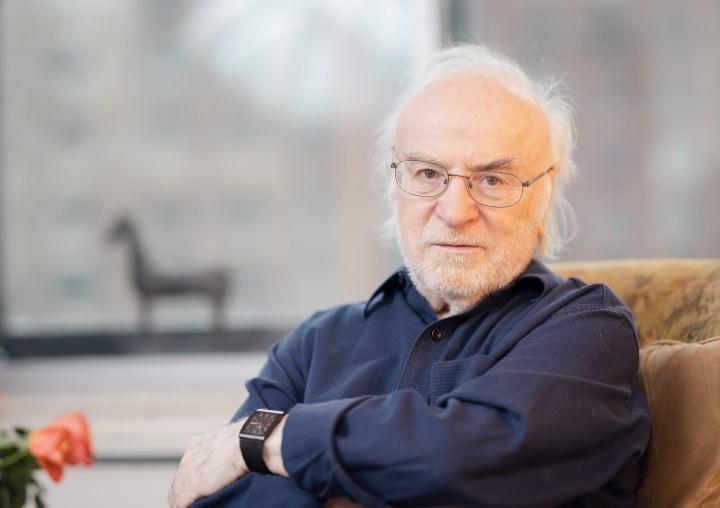
NORMAN MANEA (born in Suceava, Bucovina, on July 19, 1936) is Francis Flournoy Professor Emeritus in European Studies and Culture and Distinguished Writer in Residence at Bard College, New York. He is the author of a long series of novels, volumes of short fiction, and essays. Originally written in Romanian and published in 30 languages, the following titles are also available in English: October Eight O’Clock (short fiction, 1992), On Clowns: The Dictator and the Artist (essays, 1992), Compulsory Happiness (novellas, 1993), The Black Envelope (novel, 1995), The Lair (novel, 2012), The Fifth Impossibility (essays, 2012), The Hooligan’s Return (novel, 2003; 2nd edition, 2013), Settling My Accounts Before I Go Away. An Interview with Saul Bellow (2013), Paradise Found: An Interview with Hannes Stein (2013), Captives (2015). Norman Manea was granted, among others, The Guggenheim Fellowship (1992), The McArthur Fellowship (1993), The National Jewish Book Award (1993), The New York Public Library Literary Lion Medal (1993), The Nonino International Prize for “Opera Omnia” (2002), Napoli Prize for Fiction (2004), Prix Médicis Étranger (2006), Nelly Sachs Prize (2011), The National Prize for Literature awarded by the Romanian Writers’ Union (2012), and the FIL Grand Prize for Literature in Romance Languages (2016). He is a member of Berlin Academy of Art (Germany, 2006), a honorary member of The Royal Society of Literature (United Kingdom, 2011), and was awarded the title Commandeur dans l’Ordre des Arts et des Lettres (France, 2009), the Romanian “Cultural Merit” Order in the rank of Commander (2006), and the National Order “Star of Romania” in the rank of Grand Officer (2016).
 CEVA LA MIJLOC