
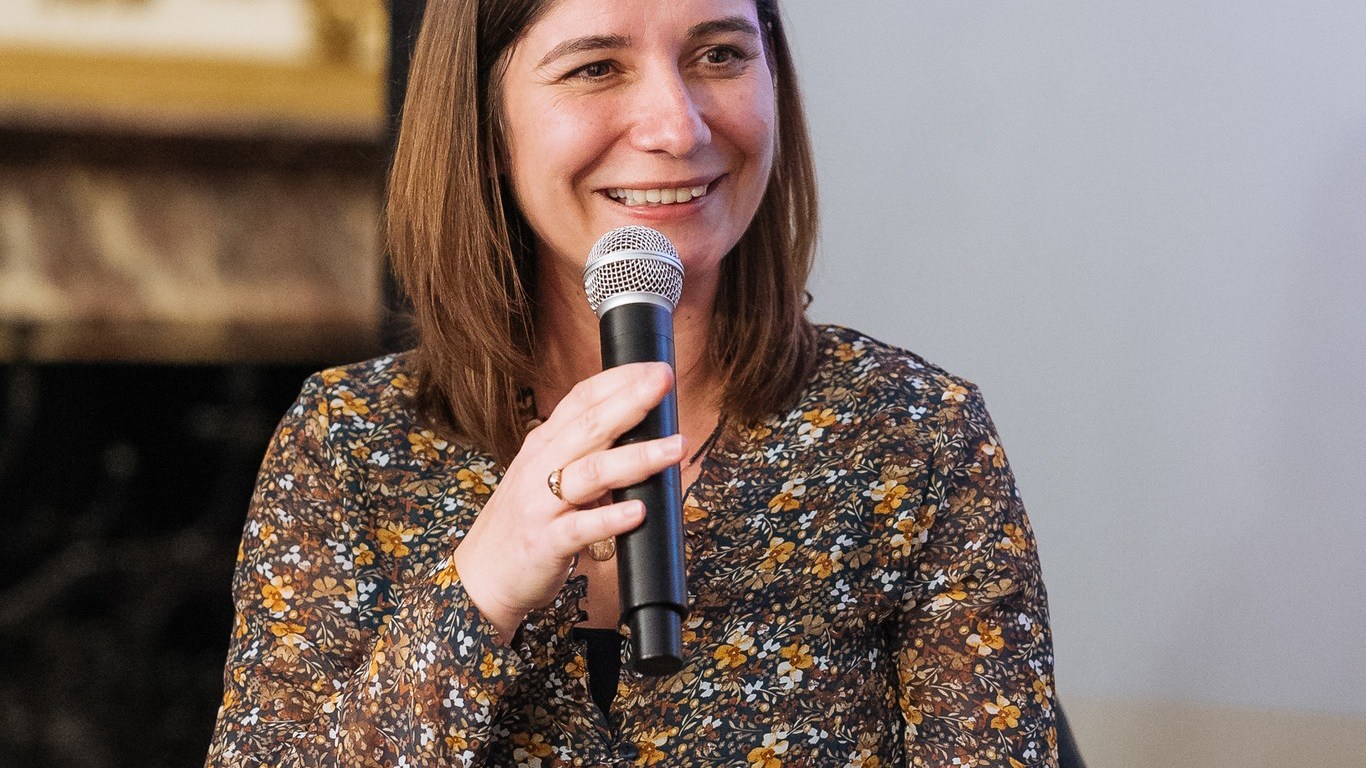

GABI REIGH moved to the UK from Romania at the age of 12 and currently teaches English at a college in Hampshire. She won the Stephen Spender Prize 2017 for her translation of Marin Sorescu’s poem “Călătorul” and was shortlisted for the Tom-Gallon Society of Authors short story award. Her translations, original fiction and articles have been published in Modern Poetry in Translation, World Literature Today, The London Magazine, Open Democracy, Los Angeles Review of Books, etc. As part of her “Interbellum Series” project, she has translated interwar novels, poetry and drama by Lucian Blaga, Mihail Sebastian, Liviu Rebreanu, Hortensia Papadat Bengescu and Max Blecher. Her translation of The Town with Acacia Trees by Mihail Sebastian (Aurora Metro 2019) received an English PEN Translates Award. Her latest publication is Virginia’s Sisters (Aurora Metro & Supernova Books, 2023), an anthology of women’s writing from the interwar period.
DB: I’ll start by asking you a question I’ve also asked Sean Cotter: how does one become a translator? How much and what kind of work goes into it? What was your personal experience?
GR: I always say that I became a translator “by accident”, after I translated a Marin Sorescu poem (“Călătorul”) on a whim and entered it into the Stephen Spender poetry competition. Winning the competition gave me a sense of confidence in my abilities as a translator and then I began approaching publishing houses with possible projects. My first project was Poems of Light by Lucian Blaga and I didn’t manage to find a publisher for it, so I decided to publish it myself through Amazon Createspace, which worked pretty well. At that point, I wasn’t very familiar with the publishing industry, I didn’t realise how difficult it would be to get the big publishers interested in poetry in translation, particularly poetry by a writer from the early twentieth century. I moved on to prose, which has a bigger market, and discovered smaller independent publishers that were particularly interested in Romanian literature. It takes quite a lot of effort to pitch translations to publishing houses, but it is satisfying when you eventually find editors who are interested in the books you love. I would advise anyone interested in translating Romanian literature to learn from my mistakes and do a lot of research into which publishers are interested in the kinds of projects you’re proposing before firing off countless fruitless emails to Penguin and the like!
DB: In 2018 you started the “Interbellum Series”, a very ambitious series of translations from interwar Romanian literature. Why did you choose that period? Wasn’t it easier to translate contemporary prose and poetry? Aren’t the themes and characters of contemporary authors more relatable? Isn’t it better to be able to chat with the author while working on the translation and then have him present at the book launch?
GR: I’ve always been interested in writing from the interwar era because it was a time of great social change across Europe, a time when the modern consciousness was formed; the books that I translated also seem important to me because they belong to the canon and I wanted to learn more about this “Golden Age” of Romanian literature. Personally, I like reading books written in the past because I think it gives me a different perspective on how people thought about life’s challenges at another point in time. As I translate these works I don’t find anything particularly alien or outdated about their point of view. Although their contexts might be different, I feel that the protagonists are struggling with similar dilemmas about the meaning of life. I’m certainly open to translating contemporary authors in the future, however, and I have already translated poetry and essays by Ruxandra Cesereanu, Aura Christi, etc. To answer your question about whether it would be useful to collaborate with a living author about translating their work, the honest answer is that I enjoy the autonomy of translating a text on my own – for me, at least, translating means rewriting and reimagining a text in a new language, giving it a new life that is to a large extent independent of the original. But yes, in terms of marketing the books it is definitely at a disadvantage that we can’t invite the authors to publicity events, and this is partly the reason why publishers are keen on taking on the works of living authors.
DB: Is there a UK readership for the classics of small literatures in translation? How were these Romanian classics received?
GR: Fortunately, there has been a wide variety of books that have been translated from Romanian literature recently and all the reviews have been very positive. Of course, there are a lot of books being published in English and it is still the case that literature in translation gets less attention and small publishers do not have the same marketing budgets as larger ones. The classics I’ve translated were well received by those who read them and by reviewers. I am also pleased that a couple of literary magazines have published my translations of short pieces by classic authors – The London Magazine has published Sorana Gurian’s short story “A Girl Walks Down the Street” and the Los Angeles Review of Books has published Max Blecher’s “Berck, the Kingdom of the Damned”, which will also be included in a volume of Blecher’s poetry, prose and letters, forthcoming later this year. All this suggests to me that early twentieth century Romanian literature can appeal to a UK or US audience.
DB: Some of the authors from that period have already been translated into English, some even recently. How do you relate to existing translations? What motivation do you need to retranslate a book?
GR: Translating and publishing a book takes a long time, and I have sometimes just finished a project when a translation of the same book has just been published. I suppose this is inevitable, especially when it comes to books that have recently entered the public domain, but it has never been my intention to retranslate books. When I started “Interbellum Series”, my aim was to translate books that I thought weren’t available in English. However, each translation is different, so there is no harm in the readers having more choice when it comes to engaging with Romanian literature.
DB: What does your relationship with publishing houses look like? How hard is it to find a publisher for your projects? Is self- publishing a solution?
GR: I’ve been fortunate to find a couple of publishers who are interested in the type of books that I like to translate and I hope that we can keep working together in the future. I’ve already mentioned that I self-published my translations of Blaga’s poetry with Amazon Createspace and I might do this again one day, especially with poetry translations, as it is more difficult to find publishing houses interested in these because the market for them is much smaller. However, I do appreciate working with editors as it is very useful to have another perspective on one’s work.
DB: Your translation of The Town with Acacia Trees by Mihail Sebastian won the English PEN Translates Award in 2019. What has changed, if anything, since receiving this award? How important are prizes for the translator, but also for the circulation of books in translation?
GR: Prizes were more important to me at the beginning of my journey as a translator because I could mention them in my proposal emails to publishing houses as evidence that I could produce work of a good quality. Now that I’ve translated a few books, I hope that publishers would feel confident entrusting me with a project due to my experience. I’m not sure that awards always have a massive impact on the circulation of books in translation, but it gives them a bit more publicity, which is always a good thing.
(…)
DB: You have translated and promoted literature written by women and you’re a writer yourself. Do you think interest in women’s literature has increased in recent years in the UK? Could this be a way for Romanian literature to successfully enter the English-speaking market?
GR: I hope so. At the moment, there are still more translations of works by male writers than literature written by women, but I think that’s beginning to change as a result of initiatives such as the “Translating Women” project and “Women in Translation” month. I’m delighted to see that Monica Cure’s translation of The Censor’s Notebook by Liliana Corobca and Sean Cotter’s translation of FEM by Magda Cârneci have had such great critical reception. Hopefully we will see more translations of Romanian women writers, from any historical period.
DB: How would you make, in general terms, a plea for Romanian books in English? Why would the British or the Americans read Romanian literature in translation?
GR: All books provide an insight into how other human beings make sense of the world, therefore it should be all the more interesting for an Anglophone reader to see how people living in other countries or even living in another century wrestled with the same existential questions. Rather than thinking about Romanian literature as a “brand” in itself, I would rather that British or American readers consider each book individually and read it if its subject matter or style appeals to them. There is a wider range of Romanian literature available in translation now, something to appeal to every taste: “literary” fiction, crime, fantasy, poetry, books by contemporary authors, classics, etc.
(…)
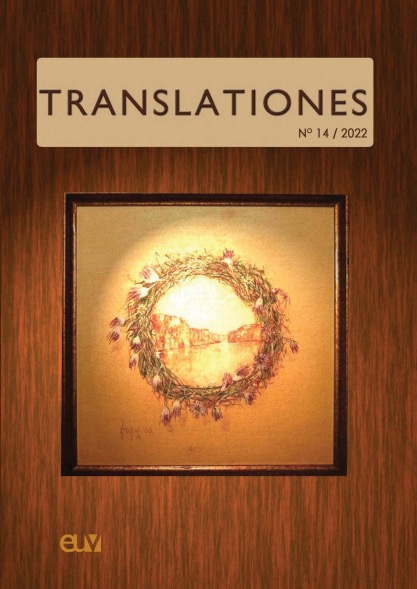
The interview was originally published in Translationes, the journal dedicated to literature in translation of the West University of Timișoara, no 14/2022. You can read the full text here.
 CEVA LA MIJLOC